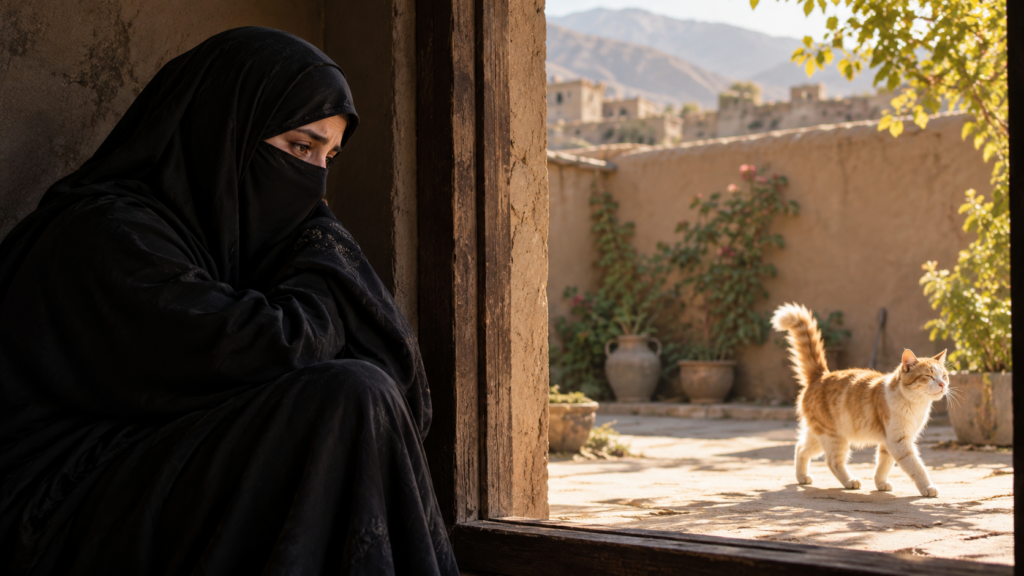
At 7:12 on a cold February morning in Kabul, nineteen-year-old Laila Rahimi was ironing her younger brother’s school shirt.
The electricity had returned twenty minutes earlier.
Nobody knew how long it would stay.
So her mother had plugged in the iron, switched on the small electric heater, and begun charging two mobile phones at the same time.
Outside, the lane was turning grey with morning.
Men pulled metal shutters from shopfronts.
A bread seller stacked warm naan behind a fogged window.
A motorcycle coughed twice before starting.
Somewhere beyond the courtyard wall, schoolboys were shouting at one another.
Laila could hear them.
She could not see them.
She pressed the iron over the sleeve of Farid’s white shirt.
“Hold still.”
“I am holding still.”
“You’re moving.”
“I’m breathing.”
Farid was sixteen and already taller than his sister.
He stood beside the table wearing one sock, trying to eat bread with honey while Laila fixed his collar.
Their mother, Soraya, poured tea.
“You’ll miss the bus.”
Farid looked at the clock.
“I have time.”
Laila smoothed the shirt.
“You always have time.”
He smiled.
“You’re jealous.”
She stopped ironing.
Farid immediately realised he had chosen the wrong word.
“I didn’t mean—”
“I know.”
Laila unplugged the iron.
Three years earlier, she had attended secondary school.
Her books still stood on a shelf in the room she shared with her twelve-year-old sister, Mina.
Biology.
Chemistry.
Dari literature.
An English grammar book with her name written carefully on the inside cover.
Laila had once planned to become a doctor.
Later, when that seemed too ambitious, she decided she might become a nurse.
Then perhaps a midwife.
Eventually, the exact profession stopped mattering.
What mattered was that every version of her future had required a classroom.
Farid put on his coat.
He picked up his backpack.
“Do you need anything from the market?”