Chapter One – The Woman at the Door
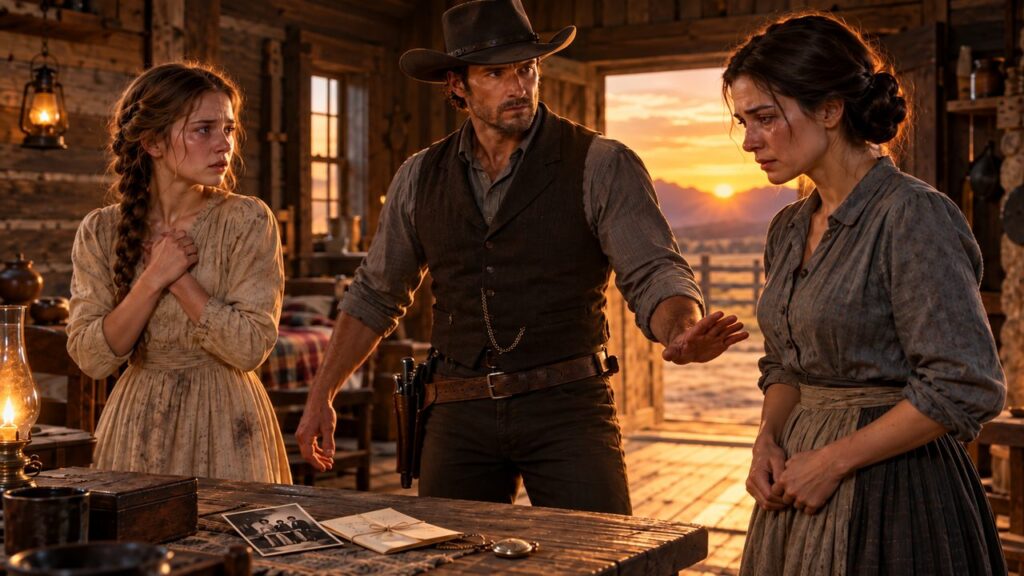
By the time the younger woman reached the cabin, the sun had already begun to fall behind the western ridge, turning the dry grass outside into long strips of copper and gold. She stood for several seconds at the bottom of the wooden steps, one hand gripping the side of her beige prairie dress while the other rested against the small leather bag hanging from her shoulder. Dust had settled along the hem of the dress, and one sleeve carried a dark smear from where she had slipped against a fence post earlier that afternoon. She had been traveling since dawn, yet exhaustion was not the reason she hesitated.
For most of her life, she had imagined this house differently.
Her mother had rarely spoken of it directly. Whenever the younger woman asked about the years before her birth, the answers became vague and strangely careful. There had been a valley, a small piece of land, and a house that once belonged to people whose names were never mentioned. Occasionally, however, her mother would stop beside a window on rainy evenings and describe a wooden cabin where the floorboards creaked during winter and the sunset entered through the front door as though it had been invited inside.
The younger woman had always assumed those memories were affectionate.
Only after her mother died did she discover the bitterness hidden beneath them.
A folded letter had been tucked into the lining of an old traveling case. Inside were several sentences written in her mother’s hand and one address.
This address.
The letter did not explain everything. In fact, it seemed almost designed to raise questions rather than answer them.
Go to the house before you decide what kind of woman I was.
That sentence had followed her across three counties.
Now, standing before the cabin, she finally understood how much she had expected the place itself to explain.
Instead, the front door opened.
An older woman appeared.
She was perhaps ten years older, dressed plainly in a greyish-blue button shirt, dark skirt, and a waist apron that suggested she had been working moments earlier. Her dark hair was gathered into a low bun. There was nothing threatening about her posture, yet she did not smile.
The two women regarded each other across the porch.
Neither asked who the other was.
Recognition arrived too quickly for that.
The older woman’s expression changed first.
Not shock.
Not exactly.
Something closer to resignation.
“You came,” she said.
The younger woman tightened her fingers around the strap of her bag.
“You knew I would?”
“I knew someone might.”
That answer irritated her more than surprise would have.
She climbed the steps.
“My mother is dead.”
The older woman’s eyes lowered for a moment.
“I heard.”
“From whom?”
No answer came.
Behind the older woman, the cabin was warm with late-afternoon light. A table stood near the wall, along with a stove, simple shelves, and a narrow hallway disappearing into shadow. Everything appeared ordinary.
That somehow made it worse.
The younger woman stepped through the doorway.
She had traveled too far to remain polite.
“Then perhaps,” she said, “you can finally tell me why my mother believed this house belonged to her.”
The older woman closed the door behind them.
Outside, somewhere beyond the cabin, a horse shifted against its tether.
Neither woman noticed that someone had arrived.