Chapter Four – The Photograph Without a Name
The older woman crossed to a narrow cabinet near the wall.
The younger woman watched every movement.
From the lowest drawer came a small box wrapped in faded cloth.
She placed it on the table.
For a moment, her hand remained on the lid.
Then she withdrew it.
“Open it.”
The younger woman did.
Inside were letters.
Not many.
Perhaps a dozen.
Beneath them lay an old photograph.
Two young women stood outside the same cabin.
One was unmistakably her mother.
The other looked like the woman standing across the table, although younger and with her hair loose over her shoulders.
They were not standing like acquaintances.
Nor even friends.
Their shoulders touched.
The younger version of her mother had one arm around the other woman.
Both wore matching oval charms.
The younger woman stared at the photograph until the image blurred.
“Who are you?”
The older woman sat down.
“My name is Ruth.”
“You know that is not what I mean.”
“No.”
Ruth folded her hands together.
“It isn’t.”
The younger woman placed the photograph on the table.
“You said you weren’t her friend.”
“I wasn’t.”
“Then what?”
Ruth’s face changed.
Whatever answer she had rehearsed over the years suddenly seemed impossible to say.
Outside, Silas remained by the door.
The younger woman noticed his shadow for the first time.
She turned sharply.
Silas stood at the threshold.
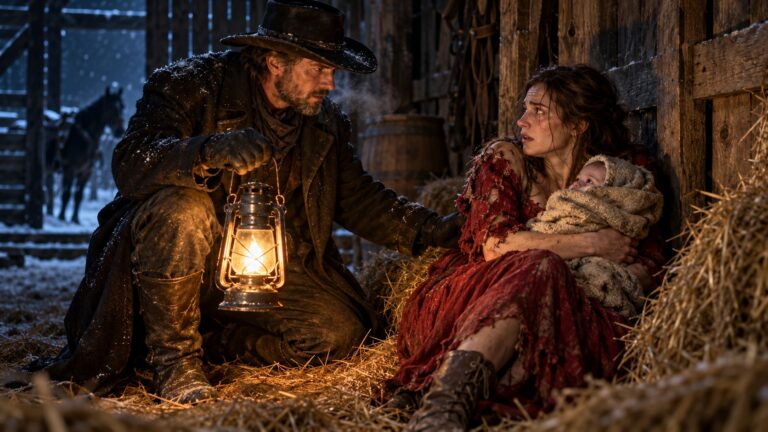
Cowboy hat low over his brow, dark vest over a grey shirt, gun holster at his side. He did not enter.
“Were you listening?”
“Yes.”
The honesty surprised her.
“And you know who she is?”
“Part of it.”
The younger woman looked between them.
“So both of you knew something about my mother that I didn’t.”
Silas answered carefully.
“That is true.”
“And you thought I should discover it like this?”
“No.”
“Then why didn’t you tell me?”
“Because it wasn’t mine to tell.”
She laughed bitterly.
“Everyone keeps saying that.”
Ruth lowered her eyes.
The younger woman looked at the photograph again.
Her mother appeared perhaps twenty in it.
Happy.
Not the restrained woman she remembered from childhood.
That difference hurt unexpectedly.
Children often believed their parents had always been the people they knew.
Seeing evidence of another version could feel like discovering a stranger hidden inside someone familiar.
“Why did she leave?” the younger woman asked.
Ruth said nothing.
“Why did she never come back?”
Still nothing.
Finally, the younger woman pointed at the photograph.
“Why did she erase you from our life?”
Ruth’s eyes filled, though no tears fell.
“Because she believed it was the only way to keep what remained.”
“What remained of what?”
Ruth looked at her.
“Of our family.”
The word entered the room with almost no volume.
Yet it changed everything.